
Guides and Decision Aids
On this page you can find a wide variety of guides and decision aids that aim to:
guide you on how to communicate health information that is accessible and easy to understand
guide you on how to work with consumers on qualitative health projects and the use of surveys
show how to find good health information online
explain how to assess the quality and credibility of health information you find online
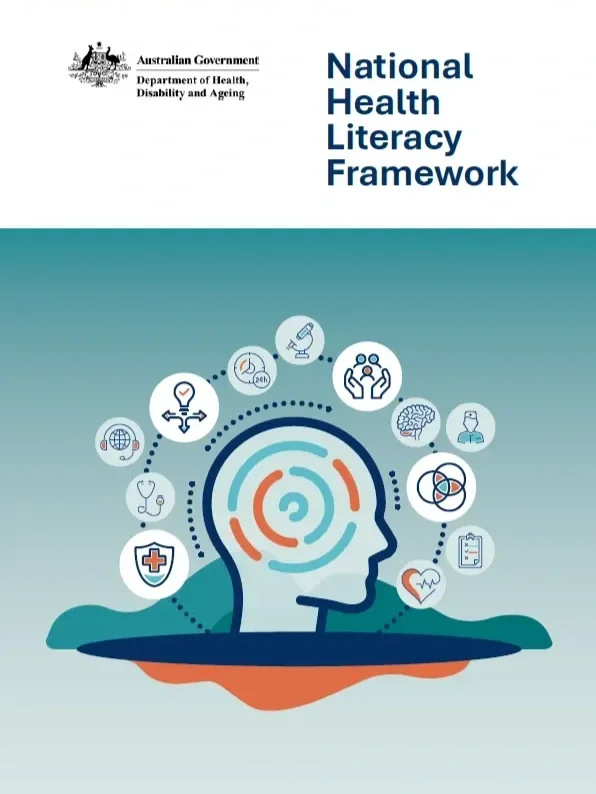
National Health Literacy Framework
The Australian Government has developed the National Health Literacy Framework, which provides a national approach to strengthening health literacy in Australia. The framework was developed by the Sydney Health Literacy Lab and the Sax Institute, drawing on the Lab's scientific expertise and extensive collaboration with more than 100 stakeholders and consumers.
The framework supports action to make health information and services easier to find, understand and use, while helping people build the skills and confidence to make informed decisions about their health and wellbeing.

This co-designed framework includes five recommendations for social media health communication for young people.
This guide is for anyone who wants to improve communicating to this priority group via social media platforms.
Qualitative health research: a guide for community
We made this guide to help researchers and consumers work together on qualitative health research projects. There are lots of different ways that consumers can get involved in research. This can change from project to project.
This guide is aimed at:
consumers: people with lived or living experience, patients, carers, family and community
consumer representatives: someone who can talk about the perspectives and experiences of many consumers
researchers: people who carry out qualitative research.
How to use ChatGPT safely for health
This guide is for anyone who would like to learn how to use ChatGPT safely for health questions.
It includes FAQs, tips and references for further reading.
Surveys in health research: a guide for community
We made this guide to help researchers and consumers work together on health research projects that use surveys. There are lots of different ways that consumers can get involved in research. This can change from project to project.
This guide is aimed at:
consumers: people with lived or living experience, patients, carers, family and community
consumer representatives: someone who can talk about the perspectives and experiences of many consumers
researchers: people who carry out qualitative research.
Digital health literacy skills


The mis-Adventures app
(A/Prof Karen Scott, The University of Sydney)
In this app, users navigate through three interactive video-based scenarios where they direct the young protagonist’s next move.
Educational videos from experts and quizzes are interspersed through different points of the scenario to reinforce learnings.
Get it on App Store or Google Play
What can you learn?
How to find health information online
How to critically appraise health information online
How to apply health information found online
How to find good health information online
Take a look at the video below by Australian Commission for Safety and Quality in Health Care with a short, sweet, and to the point guide on how to find good health information online.
Learn More
Can You Spot The Problem With These Headlines?
Puzzle through a set of hypothetical health studies and headlines and see if you can spot what’s misleading about the headline.
In medicine, there’s often a disconnect between news headlines and the scientific research they cover. While headlines are designed to catch attention, many studies produce meaningful results when they focus on a narrow, specific question. So how can you figure out what’s a genuine health concern and what’s less conclusive?
Lesson by Jeff Leek and Lucy McGowan, directed by Zedem Media.
How to assess the quality of health research?
It is great when your source provides references!
BUT it is important to assess the quality of the research cited in the sources you find online.
These 12 summary points by Bond University researchers on “How to Assess Claims Critically(H.A.C.C)” give you a great overview on how to assess the quality of health research.
Find H.A.C.C and more tools by Bond University here.

The Credibility Framework
This easy mnemonic can help you identify red flags in online content!
CRABS - The Credibility Framework
This framework is designed to help you scan whatever you are reading, scholarly or non-scholarly, and identify anything that might need further consideration.
You can read the full paper explaining CRABS (with references) here.
You can download and share this easy-to-use resource flyer here. Please be sure to creditDr Jessica Stokes-Parish, Bond University as the author.

CRAAP
CRAAP


CRAAP is an acronym for Currency, Relevance, Authority, Accuracy, and Purpose. Use the CRAAP Test to evaluate your information sources for reliability and trustworthiness.
The CRAAP test was developed by Sarah Blakeslee and her team of librarians at California State University, Chico(CSU Chico)

Sources:
Blakeslee, Sarah (2004) "The CRAAP Test," LOEX Quarterly: Vol. 31: No. 3, Article 4.
Available at: https://commons.emich.edu/loexquarterly/vol31/iss3/4
Key concepts for thinking critically about health claims.
Check out thatsaclaim.org for a breakdown of each of the points in the detailed poster below! Or download the poster here.
-
BEWARE of claims that have
a bad basis
Many claims about the e ects of
treatments are not trustworthy. O en
this is because the reason (the basis)
for the claim is not trustworthy.
You should be careful when you hear
claims that are:
• Too good to be true
• Based on faulty logic
• Based on trust alone
-
THINK ‘FAIR’ - and check the evidence from treatment comparisons.
Evidence from comparisons of treatments can fool you. You should think carefully about the evidence that is used to support claims about the effects of treatments.
Look out for:
• Unfair comparisons of treatments
• Uncareful summaries of
comparisons
• How treatment effects are
described
-
TAKE CARE - and make good choices
Good treatment choices depend on
thinking carefully about what to do.
Think carefully about:
• What your problem is and what
your options are
• Whether the evidence is relevant
to your problem and options
• Whether the advantages are better than the disadvantages

Examine health claims critically
Use the ‘Rough Guide to Spotting Bad Science’ to recognise bad science reporting, or faults in scientific studies. Equip yourself with the tools to separate science from pseudoscience.

Watch this video about the best practices in research. Here’s the description:
“Every day, we are bombarded by attention grabbing headlines that promise miracle cures to all of our ailments -- often backed up by a "scientific study." But what are these studies, and how do we know if they are reliable? David H. Schwartz dissects two types of studies that scientists use, illuminating why you should always approach the claims with a critical eye. “
Lesson by David H. Schwartz, animation by Augenblick Studios.
This ≠ That
This ≠ That
Association is not the same as causation.
Online sources, including news articles, studies, and social media, often make claims based on correlations without establishing causation. Being aware of this helps you sift through information and avoid accepting unfounded or exaggerated claims.
